


|
| |
| FIRE
MANAGEMENT REQUIREMENTS
This section presents requirements that must be met for fire management activities, which include wildfire suppression and prescribed burning, both broadcast and non-broadcast. “Conservancy Lands” refers to lands owned or managed by the Conservancy. This section also refers to “Conservancy Representatives.” See Who is a Representative of The Nature Conservancy? for how this is defined. Exceptions to these requirements may be granted by the Director of Fire Management or their designee, based on a written request. Consult the Director of Fire Management if you have an unusual situation that does not fit these requirements. GENERAL REQUIREMENTS The following requirements (1-8) apply to all fire management activities. 1. Review of Laws and Regulations A Review of Laws and Regulations must be completed before any prescribed burn or wildfire suppression activities are conducted (a) on Conservancy Lands, or (b) on third party lands by Conservancy Representatives or Conservancy Contractors. The purpose of the Review of Laws and Regulations is to investigate and understand all the laws and regulations controlling fire management in the geography where it is conducted. The Review ensures that all fire management activities adhere to applicable laws and regulations. See the Review of Laws and Regulations for specific guidance on this requirement. Completion of the review is confirmed in the "TNC Documentation" attachment to the Prescribed Burn Plan. Only qualified personnel, at least 18 years of age, may participate in fire management activities with or for the Conservancy. Conservancy Representatives must maintain documentation of their training and experience, including copies of their training certificates, completed position task books, and a log of their fire experience. See Personnel for complete information on qualification standards, training, and other administrative issues related to qualifications. 3. Personal Protective Equipment (PPE) Conservancy Representatives and Conservancy contractors actively involved in a fire management must wear fire-protective clothing 1, hard hat, leather gloves, fire/heat resistant boots 2, eye protection, and carry fire shelters. Conservancy Representatives should be trained in the uses, advantages and drawbacks of their personal safety equipment. A first aid kit must be available on Prescribed Burns.See Requirement #22 Fire Shelters for exemptions to the use of fire shelters on prescribed burns, and Requirement #26 Burning After Dark regarding use of headlamps after dark. Chainsaw Operator and ATV/UTV Operator provides position-specific PPE requirements. Occupational Safety and Health Administration (OSHA) specifies general requirements for PPE for fire work in the U.S.
4. Annual Fitness Screening and Safety Refresher Conservancy Representatives actively involved on a fire management must be screened annually for physical fitness and participate in annual fireline safety refresher training. Conservancy Representatives must demonstrate physical fitness using accepted testing methods to remain current in position qualifications. The minimum level of required fitness varies among wildland fire positions as noted in the personnel section of this manual and in Wildland Fire Qualification System Guide PMS 310-1. Generally, fireline positions on wildfires require an arduous fitness level, and prescribed burn positions require either a moderate or arduous fitness level. As exceptions, Observer and Supervised Participant positions do not require fitness testing. See the individual position descriptions in the Personnel section of this manual for minimum requirements for specific positions in the US. The Prescribed Fire Manager may require an increased level of fitness for any position on specific burns or locations, depending on factors such as topography, fuels, and vehicle access. See Physical Fitness Testing for a full discussion of fitness testing procedures. Conservancy Representatives actively involved in fire management must attend an annual safety refresher. It is the responsibility of the Prescribed Fire Manager and Burn Boss to be sure this refresher takes place and all relevant personnel can attend. Online options are available. See Annual Safety Refresher Guidelines for specific instructions. 5. Reporting Incidents Incidents related to fire management activities1 must be reported as soon as possible, typically within 12-24 hours or less, to the BU Fire Manager, Director of Fire Management or their designee, program or project director, and assigned Conservancy attorney. Certain incidents must also be reported to the Conservancy's Insurance Agent (generally by the Conservancy's Corporate Insurance Team). Generally, a written summary of the incident must be filed within four weeks of the incident, unless directed otherwise by the Director of Fire Management or Conservancy attorney. 1 Activities include fire suppression, prescribed burns including pile burning and burn assists, pre-burn activity including fire break construction, post-burn patrol and mop-up, and training outside of a classroom setting. Incidents to report include:
A review must take place following an injury requiring professional medical attention. The extent of the review is dependent on the seriousness of the events and the partners involved in the burn. It must be sufficient to identify the cause of the injury and whether steps must be taken to correct training or equipment procedures to prevent a similar accident from occurring in the future. Any workplace injury that involves inpatient hospitalization, an amputation, or eye loss must be reported to OSHA within 24 hours. Also, a work-related fatality must be reported to OSHA within 8 hours. Reports can be made by phone to 1-800-321-OSHA (6742). More details can be found in OSHA Reporting. This does not replace the Worker's Compensation reporting process or requirement, which should also be done within 24 hours of a workplace injury. Conservancy staff can reference Fire Incident Response Protocol (Internal Connect link) for guidance on dealing with Serious Incidents. Examples of Serious Incidents include: an injury resulting in admission to a hospital for something more than observation; suspected fatality; Fire Shelter deployment; property damage or operating loss initially estimated at $50,000 or more (damage value may be difficult to determine at the scene); and situations which may receive significant negative attention by the public or media. 6. Annual Summary Reports Annually, each Conservancy Business unit must report fire management information to the Director of Fire Management for insurance reporting and tracking purposes. Prescribed burn information must list each Conservancy-led burn by preserve or location, the date(s) of the burn, name of the Burn Boss, the date(s) of the burn, the name of the Burn boss, the type and size of the burn, and other relevant information. Reporting includes all broadcast and non-broadcast burns conducted on Conservancy Lands, all burns led by Conservancy Representatives or Conservancy contractors on the lands of others, and all assistance by Conservancy Representatives or Conservancy contractors on the burns of others. Wildfires occurring on Conservancy Lands must also be reported. This information is essential for tracking, planning, and training purposes. Reporting is done here (Internal Connect link). 7. Emergency Preparedness and Response Conservancy Representatives actively involved in fire management must be prepared to respond to emergencies, including the ability to: call for assistance from the nearest medical, fire or law enforcement authorities; provide basic first aid and CPR; and use fire extinguishers on vehicles (cars, trucks, ATVs, UTVs, and other types of vehicles). Emergency contact numbers are in the Communications sections of Prescribed Burn Plans and Incident Action Plans. Burn Bosses or Incident Commanders will provide these numbers to individuals as part of briefings. Methods of communication may involve radios, cellular phones, or other forms of communication. Conservancy personnel will have First Aid and CPR supplies readily available and adequately trained personnel available to render first aid. Portable fire extinguishers must be installed and available on Conservancy vehicles and field equipment used in fire management activities. Fire Extinguishers must be regularly inspected, recharged, or replaced according to manufacturer recommendations. 8. Wildfire Reporting Wildfires, regardless of origin, must be reported to the appropriate fire control agency. Responsibility for a wildfire must be turned over to fire control authorities, unless a mutual aid or other cooperative agreements have been established in writing. Wildfires on Conservancy Lands must be reported internally by Conservancy Business Units. Wildfire refers to any type of unplanned and uncontrolled fire in an area of combustible vegetation (e.g., fires started by natural causes (lightning) or human causes, including arson, accidents, and escaped fire from prescribed burns). A Review of Laws and Regulations should list appropriate fire control authorities and reporting methods. Under no circumstances should the Conservancy decide to allow a wildfire to burn unreported. On large remote landscapes, naturally ignited fire may be an important means of accomplishing resource management goals. There may be instances where naturally ignited fires can be managed for benefit on Conservancy Lands. This is most likely to be appropriate when such lands are near or within a large federal landholding. Naturally ignited fires on Conservancy Lands must be reported immediately to appropriate suppression authorities, who will either manage or suppress the fire. PRESCRIBED BURN REQUIREMENTS The following requirements (9-29) establish standards specifically for prescribed burn activities. Planning or conducting prescribed burns for The Nature Conservancy must follow the following Prescribed Burning Requirements below and the General Requirements above. 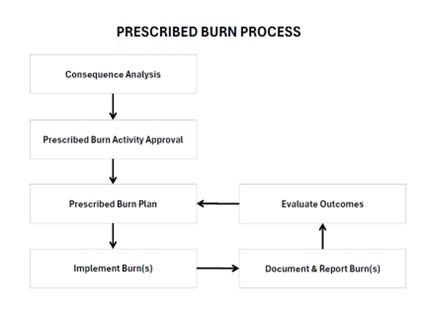 9. Consequence Analysis and Assigned
Ranking A consequence analysis is a technical assessment of the factors related to the prescribed burn, including the value of improvements or other fire-sensitive assets around the burn, the proximity to smoke-sensitive areas such as roads or developed areas, and being located in areas prone to high-intensity wildfire that may be difficult to manage. The consequence analysis assigns the prescribed burn a “ranking” of green (low consequence), yellow (medium consequence), red (high consequence), or black (“No-Go”) according to the technical assessment of the relevant factors and risks. A consequence analysis must be prepared by the responsible Business Unit and approved by the Prescribed Fire Manager for all prescribed burning: (a) on Conservancy Lands, or (b) led by Conservancy Representatives or Conservancy contractors, and c) before entering into an agreement for live fire activities with third parties. If a Prescribed Fire Manager is unavailable, the Director of Fire Management or their designee must provide approval. For prescribed burns assigned a yellow or red ranking, the Director of Fire Management (or their designee) must also review and approve the consequence analysis. If the Consequence Ranking is Green (low) and the Prescribed Fire Manager who approves the analysis also conducted it, a technical review is required by either another Prescribed Fire Manager or the Director of Fire Management, or their designee. See the Planning- B. Consequence Analysis section of the Manual (Internal Connect link) for additional details. 10. Prescribed Burn Activity Approval The Conservancy must approve all prescribed burns (including non-broadcast burns) (a) on Conservancy Lands or (b) led by Conservancy Representatives or Conservancy contractors. Prescribed Burn Activity Approval must correspond to its Consequence Analysis ranking level, per Section 6D of the Fire Management SOP. See the Planning- C. Prescribed Burn Activity Approval section of the Manual (Internal Connect link) for additional details. 11. Burn Plans Prescribed Burns (including non-broadcast burns) (a) on Conservancy Lands or (b) led by Conservancy Representatives or Conservancy contractors must be conducted according to a written approved Prescribed Burn Plan. A daily Incident Action Plan (IAP) is encouraged but not required. Prescribed Burn Plans for burns led by Conservancy Representatives or Conservancy contractors must be signed and dated by the Prescribed Fire Manager before the burn is conducted. For a burn with Consequence Analysis rankings of Red, additional approval of the Prescribed Burn Plan is required by the Director of Fire Management or their designee (per Section 6D of the Fire Management SOP). See the Burn Plans page of the manual for additional details. Non-broadcast burns (e.g., burning brush piles, old structures, or spot burning invasive plants) must have an approved burn plan. See the Format of the Non-broadcast Burn Plan for additional details. When burning on non-Conservancy land, the Conservancy must obtain in writing permission to enter the property and permission to burn the property. This must be accompanied by a map defining the burn area boundaries. Written permission may take the form of a document signed by the landowner, or it may be included in an MOU or other management agreement developed with a government entity or other conservation partner. It is often advisable to seek other waivers of liability. See the Fire Administration-Special Situations (Internal Connect link) for more information on burning on non-Conservancy land. Permission to burn forms and waivers are found on the Fire Management Legal Resource (Internal Connect link) page. 13. Burn Size Urban broadcast burns (a) on Conservancy Lands
or (b) led by a Conservancy Representative or Conservancy
contractor must not exceed 100 acres. Urban broadcast burns are
those within 1/2 mile of a town limit or urban population center
with a population greater than 5,000. The management of smoke is
the primary concern for this criterion. 14. Crew Size Broadcast prescribed burns led by a Conservancy Representative or Conservancy contractor should have at least 6 qualified individuals, including the Burn Boss. Adequate numbers of personnel will serve needed functions on a burn, including: command, ignition, holding, contingency, initial attack, and other (spotters, weather and fire behavior monitoring, communications, etc.). Qualified individuals may serve multiple operational functions as directed by the Burn Boss. No individual should directly oversee more than six people (span of control). The Prescribed Fire Manager may approve a broadcast burn with less than 6 qualified individuals if the burn is rated as Low Complexity and has minimal containment concerns, but a broadcast burn may have no fewer than four qualified individuals under these circumstances. Non-broadcast burns must have at least two
individuals, including a burn leader, meeting the minimum
qualifications required by the relevant burn plan. 15. Prescribed Burn Leadership For burns led by Conservancy Representatives or Conservancy contractors, all individuals in leadership roles (such as Burn Boss, Line Boss, Firing Boss, and Contingency) must have relevant experience with the vegetation, climate, tools, and tactics required for their assigned role on a specific prescribed burn. For prescribed burns led by Conservancy
Representatives, the Prescribed Fire Manager for the area where
the burn will occur must approve the Burn Boss in writing. See the
Position Documentation of the Burn Boss section of the manual for
more details. Minimum qualification levels for burn leadership are
found in the Prescribed Burn Plan section, including required
qualification levels for the leaders of non-broadcast burns. 16. Burn Day Decisions For the purposes of the Fire Management SOP,
“Burn Day Decisions” include Ignition Authorizations and Pre-Burn
Notifications as described below. a. Ignition Authorizations Ignitions of prescribed burns, including non-broadcast burns, by Conservancy Representatives must be authorized by the Conservancy Business Unit responsible for the prescribed burn (“Ignition Authorization”). The Burn Boss (and burn leader for non-broadcast burns) must obtain Ignition Authorization from the Prescribed Fire Manager to administratively authorize ignition of a prescribed burn within an identified period. Using a TNC or NWCG Ignition Authorization form is required when a) required in the Prescribed Burn Plan or b) the Consequence level is high (Red). When the Consequence level is high (Red), the written Ignition Authorization must be approved by the business unit’s Prescribed Fire Manager and the Director of Fire Management or their designee. Ignition Authorization is typically obtained within 24 hours prior to the start of a burn and is documented on the Go/No-Go Checklist. However, a Prescribed Fire Manager can pre-authorize a list of specific prescribed burns (e.g., location, unit name and size) up to 90 days before ignition for burns with Consequence rankings of low (Green) or medium (Yellow). A dated pre-authorization list provided to the burn boss by the Fire Manager becomes part of the Burn Documentation. If a Prescribed Fire Manager is also serving as the burn boss or the designated Fire Manager is not available, Ignition Authorizations must be obtained from either a Supporting Fire Manager or the Director of Fire Management or their designee. b. Pre-burn Notifications Conservancy Representatives and Conservancy contractors must notify the relevant Conservancy Prescribed Fire Manager (or Supporting Fire Manager) within 24 hours prior to ignition of all prescribed burns, including non-broadcast burns. The BU Director or their designee must be notified of all burns with a Consequence ranking of Yellow or Red. The Burn Boss (or burn leader for non-broadcast burns) must notify the Conservancy Prescribed Fire Manager, and BU Director when required, of their intention to burn no more than 24 hours prior to the start of a burn. The Burn Boss/burn leader will document the notification on the completed Go/No-Go Checklist. An Ignition Authorization and a pre-burn notification to the Prescribed Fire Manager may occur in a single interaction prior to the start of the burn. If a Prescribed Fire Manager is also serving as the Burn Boss, or they are not available, notifications must be made to either a Supporting Fire Manager or the Director of Fire Management or their designee. 17. Pre-burn Go/No-Go Checklist A Go/No-Go Checklist must be completed and
signed for all Prescribed Burns (including non-broadcast burns)
led by Conservancy Representatives and Conservancy contractors.
The Burn Boss, or Fire Leader for non-broadcast burns, will
complete and sign the checklist immediately before conducting the
burn. The Prescribed Burn Plan will include the appropriate
checklist to be completed. Broadcast Burn Go/No-Go Checklist. Non-broadcast Burn Go/No-Go Checklist. 18. Weather Forecast Prescribed burns (including non-broadcast burns)
must have a professional weather forecast obtained before
initiating the burn that predicts appropriate weather consistent
with the weather prescription of the approved Prescribed Burn
Plan. 19. On-site Weather Monitoring Prescribed burns (including non-broadcast burns) led by a Conservancy Representative must monitor the weather at intervals while actively burning. Broadcast burns must monitor Wind Speed and Direction, Relative Humidity, and Air Temperature at intervals throughout the burn. Tables, computer programs, fuel sticks, or direct measurement tools are often used to estimate the most relevant burn-time fuel moisture, such as Fine Dead Fuel Moisture, for comparing actual weather observations to the approved weather prescription. 20. Crew Briefing On burns led by a Conservancy Representative,
before ignition, the Burn Boss or the non-broadcast burn leader
will conduct a crew briefing for individuals on the burn. 21. Test Fire On burns led by a Conservancy Representative, a test fire will precede broadcast burns. The Burn Boss will determine the location and duration of test fires following the parameters listed in the approved Prescribed Burn Plan. 22. Fire Shelters Fire shelters must be available to and worn by Conservancy Representatives. The Prescribed Fire Manager may exempt the use
of fire shelters where local conditions justify such exemption. In
such instances, the Prescribed Burn Plan must identify that
carrying fire shelters is optional. On burns where their use is
waived, a shelter must be available to any crew member who desires
one. Fire Shelters are not required on non-broadcast burns when
snow or surrounding fuels clearly prevent the possible spread of
fire beyond the piles. 23. Communications Prescribed Burns (including non-broadcast burns) led by Conservancy Representatives and Conservancy contractors must have a cellular phone or other reliable way to communicate in the event of an emergency. Broadcast burns must have two-way radios; at a minimum, there must be a radio for the Burn Boss, each line boss/squad boss, and each engine. 24. Backup Water A backup water delivery system must be available for prescribed burns (including non-broadcast burns) where containment depends on mechanized water delivery. The exact nature of the backup water system is dependent on the individual burn and must be described in the burn plan. Backup systems may include, for example, an engine, an ATV with a sprayer, water “pumpkins” or containers, and portable pumps and hoses. The intent is to ensure a reasonable backup water supply is available in case of mechanical or vehicle failure of primary water delivery equipment. Where appropriate, other standby mechanized fire suppression equipment, such as a dozer or tractor plow, may be useful for suppressing fire should primary water delivery fail. 25. Drones For the use of drones on Prescribed Burns led by
Conservancy Representatives or Conservancy contractors, drones
must be:
26. Burning After Dark If a prescribed burn (including a non-broadcast
burn) led by a Conservancy Representative or Conservancy
contractor is expected to begin or continue after dusk, it must be
stated in the burn plan. The permitting/authorization processes of
some states may be more restrictive and limit burning to daylight
hours only. This information should be covered in the Review of
Laws and Regulations. 27. Post-Ignitions Departure Prescribed burns (including non-broadcast burns) on Conservancy Lands or led by a Conservancy Representative or Conservancy contractor must be monitored until they are completely out. The Burn Boss or non-broadcast burn leader determines when it is safe to dismiss the crew and assign individuals to monitor or patrol the burn. The criteria for this decision should be included in the burn plan. 28. Burn Documentation Documentation for prescribed burns led by a Conservancy Representative will be completed by the Burn Boss or non-broadcast burn leader and retained following the Conservancy’s record retention schedule. Each Prescribed Fire Manager will establish expectations for specific documentation content, format, and storage. An example of typical burn documentation includes:
29. Post-Burn Critique/After Action Review On burns led by a Conservancy Representative, a critique to discuss the day's operations should follow every burn. The After Action Review (AAR) found in the Incident Response Pocket Guide (IRPG) can be followed, or another suitable format may be used. The Burn Boss or non-broadcast burn leader should capture the key lessons learned from the burn, especially what went well and what went poorly. Post-burn fire effects monitoring is useful in
determining the environmental and ecological effects of the burn.
Such monitoring may be described in the burn plan, land management
plans, of Site Fire Management plans. Generally, fire effects
monitoring relates to the ecological objectives listed in the
Prescribed Burn Plan, Goals and Objectives plan element. Last updated December 30, 2025.
|
The Nature Conservancy is a nonprofit, tax-exempt charitable organization (tax identification number 53-0242652) under Section 501(c)(3) of the Internal Revenue Code. Donations are tax-deductible as allowed by law.
| Copyright 2025 The Nature Conservancy | Home | Terms of Use | Privacy Policy | Charitable Solicitation Disclosure |
